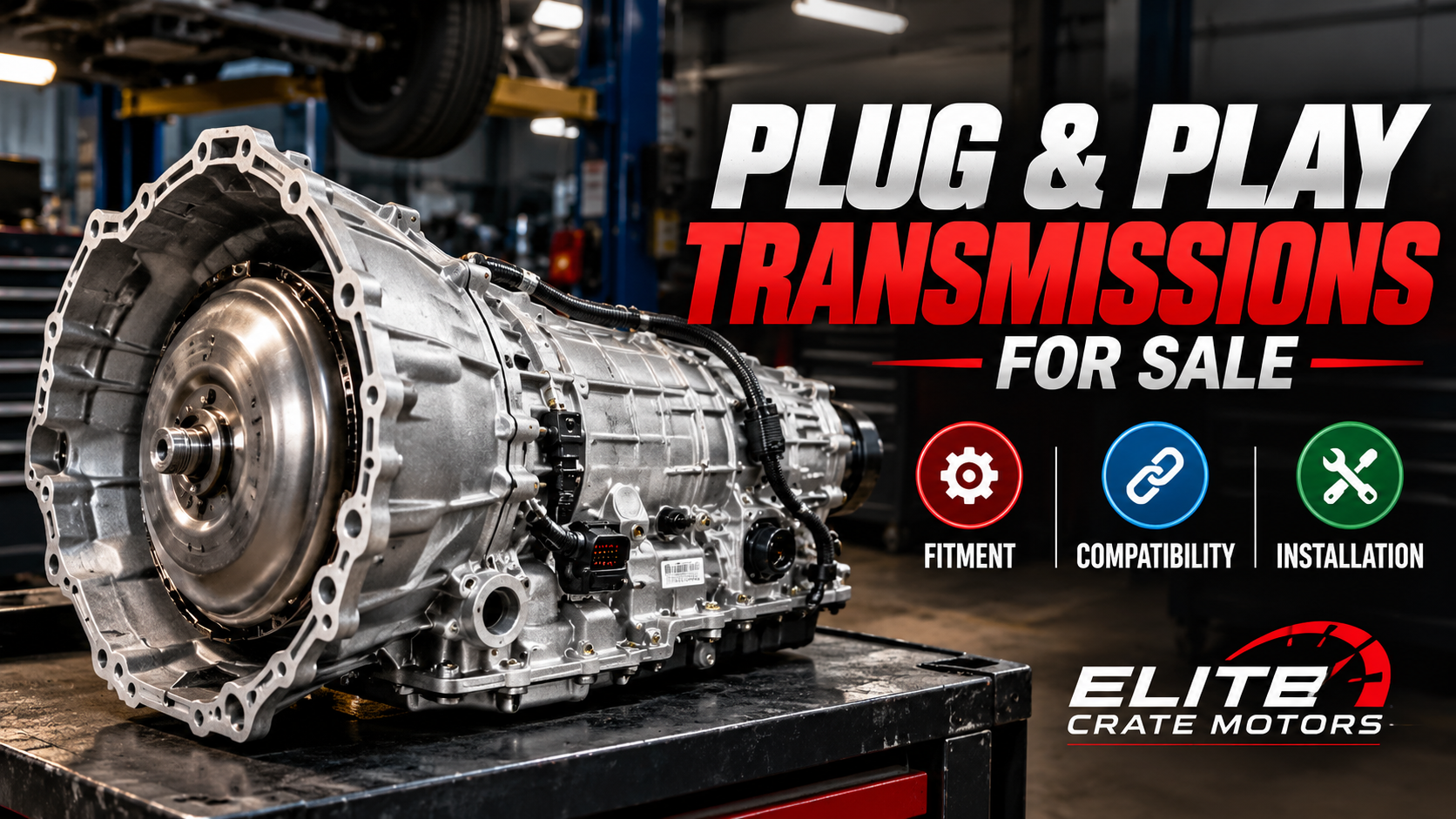
If you’re searching for plug and play transmissions for sale, you probably want one thing above everything else: the right transmission without unnecessary complications.
That’s completely understandable.
A transmission replacement is not the kind of purchase where you want to discover after delivery that the transmission has the wrong configuration, doesn’t match your drivetrain, uses a different application, or requires components you didn’t know you needed.
As a transmission vendor, one of the most important lessons we emphasize at Elite Crate Motors is simple:
Don’t start with the price. Start with the fitment.
Once you know exactly which transmission your vehicle requires, comparing condition, availability, warranty, shipping, and total cost becomes much easier.
And this is particularly important with the phrase “plug and play.”
A plug and play transmission is generally intended to make replacement more straightforward because it is designed around a particular vehicle application. But “plug and play” does not mean universal, and it does not automatically mean that installation requires no professional work.
Your vehicle still determines what transmission you need.
This guide walks through the process from identification and fitment to compatibility, installation, purchasing, and final verification so you can approach your transmission replacement with much more confidence.
What Does “Plug and Play Transmission” Actually Mean?
Let’s start by clearing up one of the most common misunderstandings.
When buyers search for plug and play automatic transmissions for sale, they are generally looking for a replacement transmission that is intended to work with their vehicle’s existing configuration without extensive custom adaptation.
In practical terms, the goal is a replacement that is designed for the appropriate application and interfaces with the vehicle’s drivetrain and related systems as intended.
But there’s an important distinction:
Plug and play describes the intended compatibility of a product. It does not eliminate the need for fitment verification.
Plug and Play Does Not Mean Universal
This is where buying experience matters.
Two vehicles can have the same:
- Year
- Make
- Model
and still use different transmission configurations.
Differences can result from:
- Engine options
- Drivetrain
- Trim or configuration
- Production changes
- Transmission codes
- Electronic systems
- Application-specific specifications
That’s why we don’t recommend approaching a transmission purchase by saying, “It’s the same model, so it must fit.”
The better approach is:
Identify the vehicle → identify the transmission → verify the application.
Plug and Play Does Not Mean Zero Installation Work
A transmission is still a major mechanical component.
Even a properly matched plug and play transmission replacement can require professional removal and installation, fluid service, diagnostics, programming, adaptation, or other vehicle-specific procedures.
The exact requirements depend on the vehicle and transmission.
So if you’re buying a ready to install transmission for sale, think of “ready to install” as referring to the intended product configuration—not as a promise that no technician, tools, or additional procedures will be necessary.
Why Transmission Fitment Comes Before Price
When comparing transmissions online, it’s tempting to sort everything by price.
That’s understandable.
But a low-priced transmission that doesn’t match your application isn’t a bargain. It is the wrong part.
For that reason, fitment should come before price.
Year, Make and Model Are Only the Starting Point
Your vehicle’s year, make, and model are essential pieces of information.
But they may not identify the exact transmission.
A single model can be offered with multiple engines, drivetrain configurations, or transmission options.
That’s why an experienced transmission buying process goes beyond the basic vehicle description.
Engine Configuration Matters
The transmission is part of the vehicle’s drivetrain system, so the engine configuration matters.
When identifying a replacement, relevant information may include:
- Engine family
- Engine displacement
- Engine configuration
- Powertrain specification
- Original transmission application
Don’t assume that a transmission used behind one engine will automatically be correct for another engine in the same vehicle model.
If you’re looking for replacement transmissions for sale, provide the engine information along with the vehicle information.
Drivetrain Configuration Matters Too
Is your vehicle:
- 2WD?
- 4WD?
- AWD?
That question can make a major difference.
Different drivetrain configurations can require different transmission applications, output configurations, or related components.
A transmission that fits a 2WD version of a vehicle should not automatically be assumed to fit the 4WD or AWD version.
This is one of the simplest questions to answer—and one of the easiest details to overlook.
How to Find the Right Transmission for Your Vehicle
If you’re wondering how to choose a replacement transmission, don’t start by scrolling through hundreds of listings.
Start by collecting the information that identifies your vehicle.
Step 1: Get the VIN
The vehicle identification number is one of the most useful pieces of information you can provide when requesting fitment assistance.
Instead of telling a vendor:
“I need a transmission for a 2019 pickup.”
you can provide the complete VIN along with the vehicle information.
That gives the fitment process a much more specific starting point.
This is why searches such as transmission fitment by VIN can be useful when researching a replacement.
However, the VIN should not be treated as the only piece of information needed in every situation. The actual transmission application and product specifications should still be verified.
Step 2: Identify the Original Transmission
If you can access the information from the transmission currently installed in your vehicle, look for:
- Transmission code
- Part number
- Model designation
- Identification tag
- Other application information
This can provide an additional reference point.
If you are uncertain about what the identification information means, that’s exactly where a qualified technician or transmission vendor can help.
Step 3: Confirm the Engine
Record the engine information available for your vehicle.
Depending on the application, this might include:
- Engine size
- Engine family
- Engine code
- Configuration
The more specific the information, the better.
Step 4: Confirm the Drivetrain
Record whether the vehicle is:
- 2WD
- 4WD
- AWD
Never leave drivetrain configuration out of a transmission inquiry when it is relevant to the application.
Step 5: Have the Specific Transmission Verified
This is the step we would never recommend skipping.
Once you’ve found a transmission listing, don’t simply assume the listing matches your vehicle.
Have the specific product and your specific vehicle application compared.
Confirm first. Order second.
That is one of the simplest ways to reduce the risk of a costly mismatch.
Understanding Transmission Compatibility
Fitment tells you whether the transmission is intended for the vehicle application.
Compatibility goes deeper.
It involves understanding whether the replacement transmission works with the mechanical, drivetrain, and electronic requirements of that vehicle.
Mechanical Compatibility
Mechanical compatibility can involve:
- Engine-to-transmission interface
- Bellhousing configuration
- Mounting points
- Output configuration
- Crossmember requirements
- Driveshaft considerations
- Related drivetrain components
The exact considerations depend on the vehicle.
This is why two transmissions that look nearly identical should not automatically be treated as interchangeable.
Electronic Compatibility
Modern vehicles add another layer.
Depending on the application, the transmission may interact with:
- Sensors
- Solenoids
- Wiring
- Connectors
- Transmission control systems
- Vehicle communication systems
- Electronic calibration
This is particularly important when purchasing a transmission for a newer vehicle.
A transmission can appear mechanically suitable while still requiring attention to electronic compatibility.
Gear Ratios and Transmission Specifications
Transmission specifications also deserve attention.
Two transmissions may both be automatic, fit similar vehicles, and still differ in:
- Number of gears
- Gear ratios
- Torque capability
- Internal specifications
- Control requirements
- Intended application
Manufacturer documentation illustrates why transmission specifications should be evaluated as a complete package rather than by transmission name alone.
This is why “it looks the same” is not a reliable compatibility test.
The better question is:
Does this exact transmission correspond to my exact vehicle application?
What Should Be Included With a Plug and Play Transmission?
One of the most important purchasing habits we recommend is checking exactly what you’re buying.
Don’t rely entirely on the product photograph.
A photograph shows you an item. The product description and confirmed inclusions tell you what you’re actually purchasing.
Complete Transmission vs. Transmission Assembly
Different sellers can use different terminology.
You may encounter descriptions such as:
- Complete transmission
- Transmission assembly
- Replacement transmission
- Remanufactured transmission
- Rebuilt transmission
- Used transmission
Don’t assume that two similarly named products contain the same components.
Read the specific listing and ask questions when something isn’t clear.
Is the Torque Converter Included?
For an automatic transmission, this is an important question.
Some products may include a torque converter while others may not.
There is no universal answer that applies to every listing.
Before purchasing, ask:
“Is the torque converter included with this specific transmission?”
That’s much safer than assuming.
What Other Components Are Included?
Depending on the particular product, buyers may also need to clarify whether components such as:
- Sensors
- Solenoids
- Wiring/connectors
- Mounting hardware
- External components
are included.
Again, don’t assume.
Confirm.
Questions Worth Asking Before You Order
If you’re purchasing plug and play transmissions online, ask the vendor:
- What is the exact transmission model?
- What is the applicable vehicle configuration?
- Does it match my VIN/application?
- What engine is it designed for?
- Is it compatible with my drivetrain?
- What components are included?
- Is the torque converter included, if applicable?
- What condition is the transmission in?
- What warranty applies?
- Is it currently available?
- What is the shipping method?
- What is the expected dispatch and transit time?
Those questions aren’t excessive.
They’re part of making an informed transmission purchase.
What Does Plug and Play Transmission Installation Involve?
This is another area where terminology can create unrealistic expectations.
A plug and play transmission may simplify compatibility, but transmission replacement itself can still be a substantial mechanical job.
Is a Plug and Play Transmission a DIY Installation?
Not necessarily.
If you’re an experienced automotive technician with the appropriate equipment, you may already be familiar with transmission replacement.
For an inexperienced vehicle owner, however, professional installation may be the more appropriate route.
A transmission is heavy and integrates with several vehicle systems. Proper support, removal procedures, installation procedures, fluid service, and vehicle-specific procedures matter.
Removing the Existing Transmission
The exact process varies considerably by vehicle.
At a high level, transmission replacement can involve:
- Preparing the vehicle
- Supporting the drivetrain
- Disconnecting applicable components
- Removing related drivetrain components
- Removing mounting hardware
- Lowering the existing transmission safely
The exact procedure should follow the appropriate vehicle service information.
Comparing the Replacement Before Installation
One of the practical checks we recommend is comparing the replacement unit with the original before installation proceeds.
Check the relevant:
- Mounting configuration
- Interfaces
- Identification information
- Output configuration
- Included components
If something doesn’t appear to match, don’t force the installation.
Stop and verify.
A five-minute verification can be far less expensive than discovering a mismatch after the transmission has already been installed.
Reconnecting the Replacement Transmission
Once compatibility has been established, the replacement transmission can be installed according to the appropriate vehicle-specific procedure.
That can include reconnecting applicable:
- Mechanical components
- Drivetrain components
- Electrical connections
- Sensors
- Mounting components
Fluid specifications and service procedures should follow the requirements for the specific vehicle and transmission.
Don’t guess on fluid type or quantity.
Programming and Relearn Procedures
Modern vehicles may require additional electronic procedures after transmission replacement.
Depending on the application, this could involve:
- Programming
- Calibration
- Adaptation
- Relearn procedures
- Diagnostic checks
Not every vehicle requires the same procedure.
That’s why the exact vehicle application matters.
Common Mistakes Buyers Make When Ordering a Replacement Transmission
The majority of transmission-buying problems don’t start when the box arrives.
They start earlier—with assumptions.
Buying by Vehicle Model Alone
The model name doesn’t always identify the exact transmission.
Always verify the application.
Ignoring the Engine
Different engine configurations can use different transmission applications.
Include engine information in your inquiry.
Forgetting the Drivetrain
2WD, 4WD, and AWD configurations can have different requirements.
Assuming Similar-Looking Transmissions Are Interchangeable
Appearance is not enough.
Transmission identification and application are much more important.
Assuming Everything in the Photograph Is Included
Always check the written product details.
Ignoring Electronic Requirements
Modern transmissions can involve electronic systems that need to be compatible with the vehicle.
Ordering Before Fitment Is Confirmed
This is the mistake that ties everything together.
If you’re unsure whether a transmission fits, don’t guess.
Ask.
How to Compare Plug and Play Transmissions for Sale
Once you know what transmission you need, you can start comparing available products.
This is where price becomes useful—but it shouldn’t be your only consideration.
Compare Product Condition
Depending on what’s available, you may encounter:
- New transmissions
- Remanufactured transmissions
- Rebuilt transmissions
- Used transmissions
These categories aren’t interchangeable descriptions.
Make sure you understand the condition of the exact unit you’re considering.
Compare the Warranty
A warranty should be read rather than merely noticed.
Look for:
- Warranty duration
- Covered components
- Exclusions
- Installation requirements
- Maintenance requirements
- Claim process
- Labor coverage, if applicable
Two products can both advertise a warranty while having very different terms.
Compare Availability
If your vehicle is already out of service, availability can affect the overall project timeline.
Ask whether the product is:
- In stock
- Ready to ship
- Available by special order
Also ask about expected dispatch time.
Compare Shipping
A transmission is not a lightweight parcel.
Before ordering, confirm:
- Shipping method
- Shipping fee
- Estimated dispatch time
- Estimated transit time
- Delivery requirements
If the shipping cost has not been provided, don’t assume a number.
Have it confirmed.
Understanding the Total Cost of a Transmission Replacement
The advertised transmission price is only one part of the project.
A better way to think about the purchase is:
Transmission + Shipping + Installation + Required Components + Fluids/Services + Other Applicable Costs = Total Project Cost
Transmission Cost
Start with the actual product.
Make sure you are comparing equivalent applications and conditions.
Shipping
Confirm the actual shipping cost and method rather than estimating.
Installation
Installation labor can vary significantly by vehicle and location.
Your installer can provide the most appropriate labor estimate for your particular vehicle.
Additional Components
Depending on the application, other parts or service items may be required.
Find out before ordering whenever possible.
Fluids and Related Services
Use the appropriate fluid and service procedures for the specific transmission and vehicle.
Diagnostic or Programming Work
If the vehicle requires programming, adaptation, or other electronic procedures, include that in your planning.
The goal is not simply to find the lowest transmission price.
The goal is to understand the complete replacement cost.
How to Buy Plug and Play Transmissions Online With Confidence
Buying online can be straightforward when you approach it systematically.
Here’s the process we recommend.
1. Gather Your Vehicle Information
Have the following available:
- VIN
- Year
- Make
- Model
- Trim
- Engine
- Drivetrain
2. Gather Your Transmission Information
If available:
- Transmission code
- Part number
- Model designation
- Identification information
- Photos of the existing unit
3. Request Fitment Verification
Give the vendor the complete vehicle information.
Don’t simply send:
“I need a transmission for my car.”
Give enough information for the application to be properly investigated.
4. Confirm Product Contents
Ask what is included in the exact transmission you’re purchasing.
5. Review the Warranty
Understand the terms before placing the order.
6. Confirm Availability
Find out whether the product is in stock or subject to additional processing time.
7. Confirm Shipping
Ask for the:
- Shipping method
- Shipping cost
- Estimated dispatch time
- Estimated transit time
8. Review the Total Cost
Consider the transmission, shipping, installation, additional components, and applicable services.
9. Place the Order
Once everything has been verified, you can proceed with much greater confidence.

What Information Should You Send a Transmission Vendor?
If you’re contacting Elite Crate Motors about a transmission, the more useful information you can provide at the beginning, the easier the fitment discussion becomes.
A strong transmission inquiry can include:
VIN
Year
Make
Model
Engine
Drivetrain
Transmission code or part number
Current transmission information
Destination
If you have photographs of the identification tag or existing transmission, those may also help depending on the application.
This is a much more productive starting point than simply asking:
“Do you have a transmission for my car?”
Frequently Asked Questions About Plug and Play Transmissions
What does plug and play mean for a transmission?
A plug and play transmission generally refers to a replacement designed for a specific application with compatibility intended to simplify installation. It does not mean that every vehicle uses the same transmission or that installation requires no professional work.
Are plug and play transmissions easy to install?
A properly matched transmission can make replacement more straightforward, but transmission installation remains a significant mechanical job. Professional installation may be appropriate depending on the vehicle and the installer’s experience.
How do I know which transmission fits my vehicle?
Start with your VIN, year, make, model, engine, drivetrain, and original transmission identification information. Then have the specific replacement product verified against your vehicle application.
Can I find a replacement transmission by VIN?
VIN information can help identify the vehicle configuration and narrow down the appropriate transmission application. Additional transmission and vehicle information should still be considered when verifying fitment.
Are plug and play automatic transmissions universal?
No. Transmission compatibility is application-specific. Vehicles with similar model names can have different engines, drivetrains, transmission codes, electronics, and other specifications.
Does a plug and play transmission include a torque converter?
Not necessarily. Inclusion depends on the specific product. Confirm the exact contents of the transmission you’re purchasing.
Does a plug and play transmission require programming?
Some vehicles may require programming, adaptation, calibration, or relearn procedures after transmission replacement. The requirement depends on the vehicle and transmission application.
Can I buy plug and play transmissions online?
Yes. Online purchasing can be convenient, but buyers should verify the exact application, product condition, inclusions, warranty, availability, and shipping before ordering.
What information should I give a transmission vendor?
Provide your VIN, year, make, model, engine, drivetrain, transmission code or part number when available, and any other identification information you have.
What is the most important thing to verify before ordering?
Fitment.
Price, warranty, shipping, and availability all matter, but none of them compensate for purchasing the wrong transmission.
Final Takeaway: The Right Transmission Starts With the Right Information
Searching for plug and play transmissions for sale is only the beginning.
The real objective is finding a transmission that corresponds to your vehicle’s specific application.
That’s why the most reliable approach is straightforward:
Identify → Verify → Compare → Confirm → Install
Identify the vehicle.
Verify the engine, drivetrain, and transmission application.
Compare the available products.
Confirm the fitment, contents, warranty, availability, and shipping.
Then have the transmission installed according to the appropriate vehicle-specific procedures.
At Elite Crate Motors, the product category we’re addressing here is plug and play replacement transmissions, but the principle applies to almost every transmission purchase:
Don’t guess about fitment. Verify it.
If you’re searching for plug and play automatic transmissions for sale, plug and play transmissions online, or a ready to install transmission, have your vehicle information ready before you request a quote or place an order.
The more precise the information you provide, the easier it is to identify the correct transmission—and the fewer surprises you’re likely to encounter later.
Next Post: Easy Engine Replacement Reman Engines Online: How to Find the Right Engine Fast


