If you’ve ever had an engine fail at the worst possible time, you already know that replacing it isn’t a decision you want to rush.
The first thing most buyers do is search for low mileage remanufactured engines for sale. Then they compare prices. Then they look at pictures. Then they see a mileage figure that looks attractive and think they’ve found the answer.
That’s understandable.
But when you’re buying an engine, the mileage number is only the beginning.
A low-mileage engine isn’t automatically the right engine. A remanufactured engine isn’t automatically identical to a new engine. And the lowest-priced engine isn’t necessarily the lowest-cost solution once shipping, installation, related components, and warranty requirements are considered.
From an engine-vendor perspective, one of the most useful things you can do before ordering is slow down long enough to identify exactly what you’re buying.
What engine is it?
What vehicle did it come from?
What was done during remanufacturing?
What does the product include?
Does it actually match your vehicle?
What does the warranty require?
And what will the complete replacement project cost?
Those questions are much more useful than simply asking, “How many miles does it have?”
At Elite Crate Motors, that’s the approach we recommend when customers are evaluating replacement and remanufactured engines. Start with the application, verify the details, and then compare the available options.
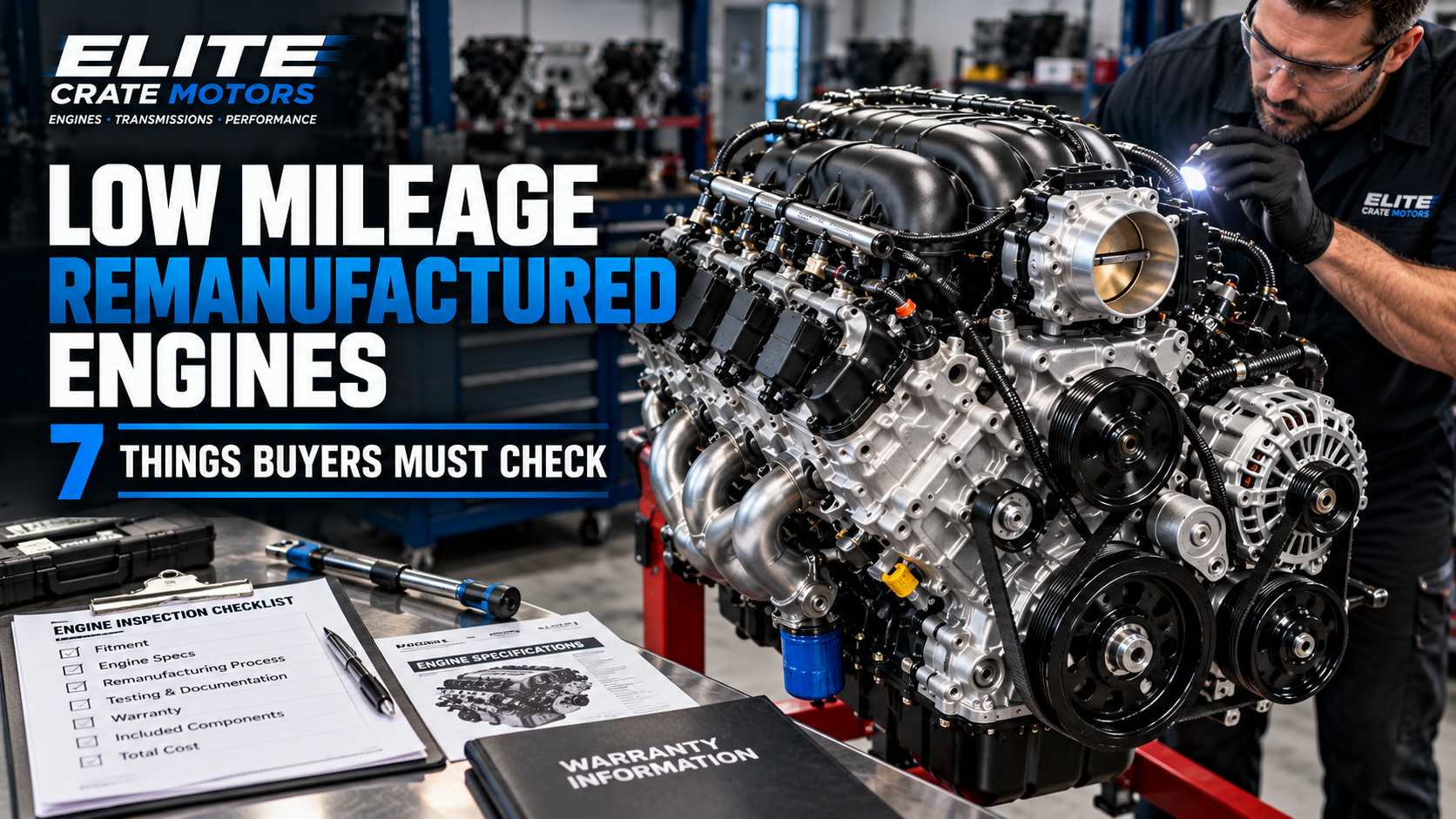
Here are seven checks every buyer should make before purchasing a low-mileage remanufactured engine.
What Is a Low Mileage Remanufactured Engine?
Let’s clear up the terminology first because “low mileage” and “remanufactured” describe different things.
A low-mileage used engine is an engine that previously operated in another vehicle and is being sold based, at least in part, on its reported operating mileage.
A remanufactured engine has undergone a remanufacturing process. Depending on the engine and remanufacturer, that process can involve disassembly, cleaning, inspection, measurement, reconditioning or machining, replacement of qualifying components, reassembly, and applicable quality-control or testing procedures.
The exact process matters.
That’s why you shouldn’t assume that every remanufactured engine has been rebuilt in precisely the same way.
Likewise, you shouldn’t assume that a low-mileage engine has experienced little wear simply because the mileage figure is low.
What Does “Low Mileage” Actually Tell You?
Mileage can be useful, but it doesn’t tell the entire story of an engine’s previous life.
Consider two engines with the same reported mileage.
One could have spent much of its operating life on the highway. Another could have been subjected to frequent stop-and-go driving, heavy loads, poor maintenance, or other demanding conditions.
The number on the odometer doesn’t tell you everything.
That is why buyers looking for low mileage remanufactured replacement engines should evaluate mileage alongside the engine’s identification, remanufacturing information, specifications, documentation, warranty, and compatibility.
The goal isn’t to ignore mileage.
The goal is to avoid treating mileage as the only measurement that matters.
1. Verify What “Low Mileage” Actually Means
This is the first question to ask because “low mileage” can sound more definitive than it really is.
Before relying on a mileage figure, find out what it represents and what documentation supports it.
Ask About the Engine’s History
Useful questions include:
- What vehicle did the engine come from?
- Is the mileage documented?
- Is the mileage associated with the donor vehicle?
- Is the engine identification confirmed?
- Is information about the engine’s previous application available?
- Was the engine inspected before remanufacturing?
You don’t need to interrogate a seller over every detail.
You simply need enough information to understand what you’re being offered.
Low Mileage Does Not Automatically Mean Low Wear
This distinction is important enough to repeat.
An engine can have relatively low mileage and still have experienced conditions that affected its components.
Operating environment matters.
Maintenance matters.
Temperature matters.
Load matters.
Storage matters.
Previous mechanical problems matter.
That’s why how to verify a low mileage engine is a better question than simply asking whether the mileage is low.
A responsible buyer doesn’t just ask, “How many miles?”
They ask, “What do we know about those miles?”
Mileage Is One Factor, Not the Whole Evaluation
If two engines are being compared, don’t automatically choose the one with the lower number.
Instead, compare:
- Reported mileage
- Engine identification
- Remanufacturing process
- Component information
- Testing information where available
- Warranty
- Included components
- Vehicle compatibility
- Total purchase cost
That gives you a much more complete picture.

2. Investigate the Remanufacturing Process
This is arguably the most important distinction between shopping for a remanufactured engine and simply shopping for a used engine.
“Remanufactured” should lead to questions.
It shouldn’t end the conversation.
What Happens During Remanufacturing?
The precise process depends on the engine and remanufacturer, but a remanufacturing process can involve:
- Core inspection
- Disassembly
- Cleaning
- Component inspection and measurement
- Machining or reconditioning where required
- Replacement of qualifying components
- Reassembly
- Quality-control inspection
- Applicable testing
The important point is that the exact process can vary.
So don’t assume a component was replaced simply because an engine is described as remanufactured.
Ask what information is available for the specific engine you’re considering.
Which Components Were Inspected or Replaced?
Depending on the engine, the remanufacturing process may involve components such as:
- Bearings
- Seals
- Gaskets
- Pistons
- Rings
- Cylinder heads
- Crankshaft
- Connecting rods
- Valvetrain components
But the exact parts involved should be confirmed against the specific product information.
This is where an experienced buyer becomes more careful.
Instead of asking:
“Is this engine basically new?”
ask:
“What was actually inspected, reconditioned, replaced, and tested?”
That’s a much more useful question.
Why the Process Matters More Than a Mileage Number
Imagine that you’re comparing an engine with an attractive mileage figure against a remanufactured engine for which the remanufacturing information, specifications, and warranty are clearly defined.
The mileage figure alone doesn’t tell you which product is the better match for your project.
You need more information.
That’s why people searching for reliable remanufactured engines for sale should look beyond a single specification and evaluate the complete product.
3. Confirm the Engine Matches Your Vehicle
This is where many engine-buying problems can be prevented before money changes hands.
An engine can look almost identical to the engine in your vehicle and still have important differences.
That’s why fitment should be verified before you become emotionally attached to a particular listing.
Start With Your VIN
Have your vehicle information ready:
- VIN
- Year
- Make
- Model
- Trim
- Original engine
- Engine code
- Displacement
- Fuel type
- Transmission
The more information you can provide, the easier it becomes to narrow down the correct application.
If you’re contacting Elite Crate Motors about a replacement engine, having this information available can make the conversation much more productive.
Verify the Engine Code
Don’t rely solely on:
“It looks like mine.”
Verify the engine family and configuration.
Depending on the vehicle, differences can involve:
- Displacement
- Fuel system
- Sensors
- Electronics
- Intake configuration
- Exhaust configuration
- Engine mounts
- Accessories
- Transmission interface
This becomes particularly important when searching for a remanufactured replacement engine for my car.
The objective isn’t merely to find an engine that can physically occupy the engine bay.
You want to identify an engine appropriate for the vehicle’s actual configuration.
Similar Engines Aren’t Necessarily Interchangeable
This is a common source of confusion.
Two engines can share a family or displacement while having differences that affect installation and operation.
That’s why we recommend giving the supplier the complete vehicle information rather than making assumptions based on photographs or general engine descriptions.
If you have an engine code or part number, provide it.
If you have your VIN, provide it.
If you have information from your mechanic, provide that too.
Good information makes good fitment decisions easier.
4. Check the Engine Specifications and Included Components
Once basic compatibility has been established, look at the product itself.
This is where you should move from general marketing language to specific specifications.
Know What Type of Engine Assembly You’re Buying
You may encounter terms such as:
- Complete engine
- Long block
- Short block
- Engine assembly
These terms can represent substantially different products.
Never assume that the product includes every component you see in a photograph.
Read the product description carefully.
If something is important to your installation, ask.
Confirm What’s Included
Depending on the specific engine, you may need to determine whether components such as these are included:
- Intake manifold
- Exhaust manifolds
- Fuel-system components
- Injectors
- Sensors
- Alternator
- Starter
- Water pump
- Accessories
- Wiring harness
The safest rule is simple:
If you need it, confirm it.
A product photograph is not a substitute for a written product specification.
Check the Major Specifications
At minimum, review:
- Engine family
- Displacement
- Fuel type
- Horsepower
- Torque
- Configuration
- Intended application
For a performance application, don’t focus on horsepower alone.
Torque characteristics, engine configuration, transmission compatibility, electronics, and intended use can all matter.
That’s especially important when evaluating low mileage remanufactured engines for cars.
5. Check Testing, Quality Control and Documentation
A professional engine purchase should be based on information that can actually be verified.
That means asking about testing and documentation instead of assuming everything has been tested in the same way.
Ask What Testing Was Performed
Depending on the engine and remanufacturing process, applicable testing can vary.
It may include things such as:
- Leak testing
- Pressure-related testing
- Compression-related testing
- Operational testing
- Quality-control inspection
But don’t assume a specific test was performed.
Ask for the information applicable to the actual product.
This is an important trust principle for engine buyers:
Never turn an assumption into a specification.
If the documentation doesn’t confirm a particular test, don’t present it as though it does.
Documentation Gives You Something Concrete to Evaluate
Useful documentation may include:
- Engine specifications
- Product details
- Remanufacturing information
- Testing information where available
- Warranty terms
- Installation requirements
Keep that information after purchase.
It can be useful for your mechanic, installer, maintenance records, and any future warranty questions.
Ask Questions Before You Pay
There is nothing unreasonable about asking detailed questions before making a major engine purchase.
In fact, it is usually easier to resolve uncertainty before an order than after an engine has already been shipped.
If a specification matters to your installation, ask about it before ordering.
If a component is required, confirm whether it is included.
If a warranty requirement could affect installation, understand it beforehand.
That is simply good purchasing practice.

6. Understand the Warranty Before You Buy
A warranty isn’t something you should discover after installation.
Read the applicable warranty information before purchasing.
Warranty terms vary by product and supplier, so don’t assume that one engine has the same coverage as another.
Ask These Warranty Questions
Before ordering, ask:
- How long is the warranty?
- What components are covered?
- What components are excluded?
- Are labor costs covered?
- Are installation requirements specified?
- Are maintenance records required?
- What circumstances can affect coverage?
- What is the warranty-claim process?
These questions help you understand what you’re actually purchasing.
Installation Requirements Can Matter
Some engine warranties can include requirements relating to installation and maintenance.
Depending on the specific product, these may address:
- Oil and filter replacement
- Cooling-system inspection
- Fluid replacement
- Proper installation
- Related-component inspection
- Break-in procedures
Always follow the warranty documentation supplied for your specific engine.
Don’t rely on a generic checklist if the actual product has different requirements.
A Warranty Doesn’t Replace Fitment Verification
This is another point worth remembering.
A warranty doesn’t make an incorrect engine correct for your vehicle.
The first question is:
Is this the correct application?
Then you evaluate:
What is the condition and remanufacturing process?
Then:
What is covered by the warranty?
Then:
What does installation require?
That sequence keeps the buying decision grounded in facts.
7. Calculate the Real Cost Before Ordering
Now we get to the number that usually attracts the most attention: price.
Price matters.
But engine price is only one part of the project.
Look Beyond the Listing Price
Your actual project cost may include:
Engine price
- Shipping
- Installation labor
- Required components
- Fluids and service items
- Programming or calibration where applicable
- Other related repairs
= Total project cost
That’s why the search for affordable remanufactured engines for sale shouldn’t become a race to find the lowest number on the screen.
The better question is:
“What will it actually cost to complete this replacement correctly?”
Don’t Forget Shipping
Engines are heavy automotive components, and shipping arrangements can affect the total purchase cost.
Before ordering, understand:
- Shipping method
- Estimated dispatch time
- Estimated transit time
- Delivery requirements
- Delivery location requirements
- Any special freight considerations
Also inspect the shipment when it arrives and follow the applicable carrier procedures if there is visible damage.
Availability Matters Too
Ask whether the engine is:
- In stock
- Available to order
- Special order
- Subject to processing or build time
If your vehicle is already at a repair facility, timing can matter just as much as price.
An engine that is perfect on paper but unavailable within your required timeframe may not solve your immediate problem.
Low Mileage Remanufactured vs. Used vs. New Engines
There isn’t one engine type that is automatically right for every buyer.
Your decision should depend on your vehicle, application, budget, availability, warranty, documentation, and desired condition.
| Factor | Used Engine | Low-Mileage Used | Remanufactured Engine | New Engine |
|---|---|---|---|---|
| Previous operation | Yes | Yes | Depends on core/history | No |
| Remanufacturing process | No | No | Yes | No |
| Component inspection | Varies | Varies | Process-dependent | Product-dependent |
| Documentation | Varies | Varies | Varies | Varies |
| Warranty | Varies | Varies | Varies | Varies |
| Price | Varies | Varies | Varies | Varies |
The point isn’t to pick a universal winner.
The point is to compare the actual products available for your particular vehicle.
When a Used Engine May Make Sense
A used engine can be appropriate for certain applications, particularly where availability, budget, or project requirements make it attractive.
But buyers should still investigate condition, history, compatibility, and warranty.
What Makes a Remanufactured Engine Different?
A remanufactured engine has undergone a remanufacturing process.
That can provide a different purchasing proposition from simply buying an engine in used condition.
But don’t confuse “remanufactured” with “brand new.”
Evaluate what was actually done to the engine.
Don’t Make the Decision From Mileage Alone
A low mileage number can be attractive.
So can a low price.
But neither one tells the complete story.
The strongest purchasing decision comes from comparing the entire package.
7 Common Mistakes Buyers Make With Remanufactured Engines
Even experienced vehicle owners can overlook important details when they’re under pressure to get a vehicle running again.
1. Assuming Low Mileage Means Low Risk
Mileage is useful information, but it isn’t a complete condition report.
2. Buying Before Confirming Fitment
A small compatibility difference can create a large installation problem.
Verify the application before ordering.
3. Comparing Only the Price
The purchase price is only part of the project cost.
4. Not Asking What Was Remanufactured
If you’re buying a remanufactured engine, understand what information is available about the process.
5. Assuming Every Component Is Included
Pictures aren’t specifications.
Confirm the contents of the actual product.
6. Ignoring Warranty Requirements
Don’t wait until a problem occurs to discover a warranty condition you didn’t know about.
7. Forgetting Installation Requirements
An engine replacement involves more than the engine itself.
Proper installation and supporting service work can affect the outcome.
Questions to Ask Before Buying a Low Mileage Remanufactured Engine
If you’re comparing best low mileage remanufactured engines for sale, keep this checklist nearby.
Engine History
Ask:
- What is the reported mileage?
- Is the mileage documented?
- What vehicle did the engine come from?
- Is the engine identification confirmed?
- What information is available about its history?
Remanufacturing
Ask:
- What was inspected?
- What was replaced?
- What machining or reconditioning was performed?
- What testing was performed?
- Is supporting documentation available?
Compatibility
Ask:
- Does it match my VIN?
- Does it match my original engine?
- Is the engine code correct?
- Does it work with my transmission?
- Which accessories will transfer?
Purchase
Ask:
- What exactly is included?
- What are the warranty terms?
- Is the engine available now?
- How will it ship?
- What is the estimated dispatch time?
- What is the estimated transit time?
These aren’t complicated questions.
But they can make a major difference in the quality of your buying decision.

Why Choose Elite Crate Motors for Your Engine Search?
At Elite Crate Motors, we approach engine purchasing as an application-specific decision rather than a simple price comparison.
The right engine depends on the vehicle.
The right configuration depends on the application.
The right purchase depends on the specifications, included components, availability, warranty, shipping, and installation requirements.
That’s why we encourage customers searching for low mileage remanufactured engines for sale to have their vehicle information ready before placing an order.
If you have your VIN, engine code, year, make, model, transmission information, or existing engine identification, provide that information when requesting assistance.
It gives the conversation a much more useful starting point.
Elite Crate Motors offers automotive engine and powertrain products for customers looking for replacement and performance solutions. Rather than assuming that the first engine that appears in a search is the correct one, use the available vehicle and product information to narrow your options.
Looking for a Remanufactured Replacement Engine?
Start with the application.
Tell us what vehicle you’re working with, what engine it currently has, and what you’re trying to accomplish.
If you have a specific engine number or part number, include it.
If you have questions about compatibility, included components, warranty, availability, or shipping, ask those questions before ordering.
That’s how you reduce uncertainty.
Frequently Asked Questions
Are Low Mileage Remanufactured Engines Reliable?
Reliability depends on multiple factors, including the remanufacturing process, component condition, product specifications, installation quality, maintenance, operating conditions, and application.
A low mileage figure by itself cannot guarantee reliability.
Is a Low Mileage Remanufactured Engine Better Than a Used Engine?
They are different product types.
A low-mileage used engine is generally being sold based largely on its previous operating history, while a remanufactured engine has undergone a remanufacturing process.
Compare the actual product information, warranty, specifications, condition, and price rather than assuming one category is automatically right for every application.
What Does Low Mileage Mean on a Remanufactured Engine?
It may refer to the reported mileage associated with the engine or its donor vehicle before remanufacturing.
Ask how the mileage was established and whether supporting documentation is available.
How Do I Know If a Remanufactured Engine Is Good?
Start with the fundamentals:
- Correct fitment
- Correct engine configuration
- Clear specifications
- Information about the remanufacturing process
- Testing information where available
- Warranty terms
- Product documentation
- Supplier support
There isn’t one mileage number or one marketing phrase that can answer all of those questions.
What Should I Check Before Buying a Remanufactured Engine?
At minimum, check:
- Mileage and history
- Remanufacturing process
- Vehicle compatibility
- Specifications and included components
- Testing and documentation
- Warranty
- Total project cost
That’s the framework this guide was built around.
How Long Do Remanufactured Engines Last?
There is no single lifespan that applies to every remanufactured engine.
Service life can depend on the engine, remanufacturing quality, installation, maintenance, operating conditions, vehicle application, and other factors.
Be cautious of universal lifespan claims that don’t account for those variables.
Are Remanufactured Engines Cheaper Than New Engines?
Pricing varies by engine, vehicle application, availability, specifications, supplier, and other factors.
Compare more than the purchase price.
Look at the warranty, included components, shipping, installation requirements, and overall project cost.
Final Takeaway: Don’t Buy on Mileage Alone
If you’re shopping for low mileage remanufactured engines for sale, the biggest mistake you can make is reducing the entire decision to one number.
Mileage matters.
But so do the details behind the mileage.
The remanufacturing process matters.
Fitment matters.
Specifications matter.
Testing and documentation matter.
The warranty matters.
Shipping and installation matter.
And the total cost matters.
Before you buy, verify the mileage information, understand what was done during remanufacturing, confirm the engine matches your vehicle, check exactly what you’re receiving, review the available testing and documentation, understand the warranty, and calculate the complete project cost.
That approach may take a few extra minutes at the beginning.
It can save you from much bigger questions later.
At Elite Crate Motors, that’s the mindset we recommend for anyone comparing low mileage remanufactured engines for sale: don’t buy based on a promising number or attractive photograph alone.
Get the details.
Verify the application.
Ask the right questions.
Then choose the engine that actually fits your vehicle, project, and requirements.
Because when you’re replacing an engine, “almost right” isn’t right enough.
Next Post: High Performance New Car Engines for Sale: 7 Things to Know Before You Buy


